'%3e%3cpath%20d='M39.45%202.007v8.24c0%20.853-.684%201.493-1.495%201.493h-8.367a1.485%201.485%200%200%201-1.494-1.494V1.922c0-.854.683-1.494%201.494-1.494h8.239c.896-.043%201.622.683%201.622%201.58Z'%20fill='url(%23b)'/%3e%3cpath%20d='M39.45%202.007v8.24c0%20.853-.684%201.493-1.495%201.493h-8.367a1.485%201.485%200%200%201-1.494-1.494V1.922c0-.854.683-1.494%201.494-1.494h8.239c.896-.043%201.622.683%201.622%201.58Z'%20fill='%23212121'/%3e%3cpath%20d='M6.66%2013.32h2.305a4.39%204.39%200%200%201%204.397%204.396v4.568a4.345%204.345%200%200%201-4.355%204.354H6.702C2.988%2026.681%200%2029.67%200%2033.34A6.668%206.668%200%200%200%206.66%2040a6.668%206.668%200%200%200%206.66-6.66v-2.305a4.345%204.345%200%200%201%204.353-4.354h4.568a4.345%204.345%200%200%201%204.355%204.354v2.305a6.668%206.668%200%200%200%206.66%206.66%206.668%206.668%200%200%200%206.659-6.66%206.668%206.668%200%200%200-6.66-6.66H30.95a4.39%204.39%200%200%201-4.397-4.396V19.04a5.72%205.72%200%200%200-5.72-5.72h-3.245a4.39%204.39%200%200%201-4.397-4.398V6.617C13.319%202.988%2010.373%200%206.66%200A6.668%206.668%200%200%200%200%206.66a6.668%206.668%200%200%200%206.66%206.66Z'%20fill='url(%23c)'/%3e%3cpath%20d='M6.66%2013.32h2.305a4.39%204.39%200%200%201%204.397%204.396v4.568a4.345%204.345%200%200%201-4.355%204.354H6.702C2.988%2026.681%200%2029.67%200%2033.34A6.668%206.668%200%200%200%206.66%2040a6.668%206.668%200%200%200%206.66-6.66v-2.305a4.345%204.345%200%200%201%204.353-4.354h4.568a4.345%204.345%200%200%201%204.355%204.354v2.305a6.668%206.668%200%200%200%206.66%206.66%206.668%206.668%200%200%200%206.659-6.66%206.668%206.668%200%200%200-6.66-6.66H30.95a4.39%204.39%200%200%201-4.397-4.396V19.04a5.72%205.72%200%200%200-5.72-5.72h-3.245a4.39%204.39%200%200%201-4.397-4.398V6.617C13.319%202.988%2010.373%200%206.66%200A6.668%206.668%200%200%200%200%206.66a6.668%206.668%200%200%200%206.66%206.66Z'%20fill='%23212121'/%3e%3c/g%3e%3cdefs%3e%3cpattern%20id='b'%20patternContentUnits='objectBoundingBox'%20width='1'%20height='1'%3e%3cuse%20xlink:href='%23d'%20transform='translate(-.247)%20scale(.00083)'/%3e%3c/pattern%3e%3cpattern%20id='c'%20patternContentUnits='objectBoundingBox'%20width='1'%20height='1'%3e%3cuse%20xlink:href='%23d'%20transform='matrix(.00084%200%200%20.00083%20-.251%200)'/%3e%3c/pattern%3e%3cclipPath%20id='a'%3e%3cpath%20fill='%23fff'%20d='M0%200h40v40H0z'/%3e%3c/clipPath%3e%3c/defs%3e%3c/svg%3e)
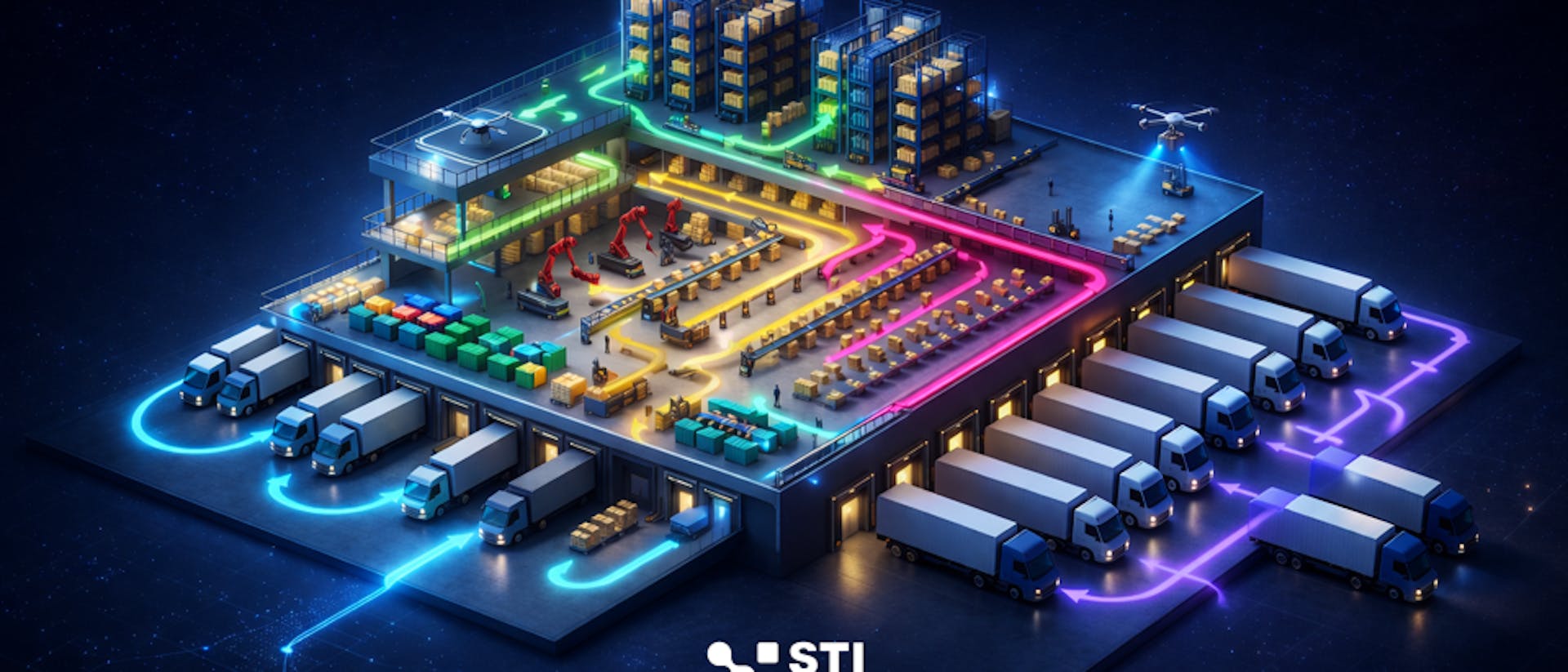
Automated Warehouses and Logistics Platforms: How to Avoid Inefficiencies and Improve Performance
An automated warehouse or a logistics platform can significantly improve operational performance. However, without thorough analysis, they risk amplifying existing inefficiencies.
Many intralogistics projects start from layouts, technologies, and theoretical capacities. Far less often do they begin with the most critical question: will the system be able to handle future variations in volume, product mix, and operational complexity?
The Limits of Traditional Design
As variability, demand peaks, and operational constraints increase, issues often underestimated during the design phase begin to emerge:
bottlenecks that appear after go-live
incorrect sizing of resources, equipment, and automated systems
automation systems performing below expectations
operating costs (OPEX) based on assumptions rather than real data
These factors highlight a key point in the design of automated warehouses and logistics systems:
it is not enough to define an efficient layout — it is necessary to understand the system’s real behavior.
Process & Logistics Engineering: An Integrated Approach
Process & logistics engineering enables structured analysis and optimization of logistics systems by integrating:
real process and logistics data
end-to-end mapping of physical and information flows
dynamic simulation of automated warehouses, lines, and resources
application of LEAN methodologies
industrial, logistics, and economic KPIs
This approach transforms design from a theoretical exercise into a data-driven decision-making process.
Logistics Simulation: A Key Tool
Logistics simulation is one of the most effective tools for evaluating alternative scenarios and supporting strategic decisions. Through dynamic models, it is possible to analyze:
actual capacity vs theoretical capacity
alternative layout configurations
stock levels and work-in-progress (WIP)
shift organization and workforce planning
sizing of equipment and handling systems
impact on CAPEX and OPEX
Simulate first, decide later: this principle reduces design risk and improves decision quality.
Scalability and Flexibility of Logistics Systems
An automated warehouse should not be designed only for current needs, but also for future evolution.
It is essential to assess the system’s ability to adapt to:
volume increases
growth in the number of SKUs (product variants)
changes in product mix
introduction of new levels of automation
layout expansions and capacity increases
Without this vision, the risk is building systems that are efficient in the short term but rigid and costly to modify over time.
CASE 1 – Greenfield Project: Food Logistics Platform, Inalca Middle East
An integrated food logistics platform developed in the Kizad area, Abu Dhabi (which we worked on), represents a concrete example of advanced intralogistics and food supply chain design.
The project involved the development of a food logistics and processing platform across a total area of 249,000 sqm, with a main logistics building of 41,000 sqm and a storage capacity of over 32,000 pallets, divided into frozen, fresh, and dry areas.
Design Challenges in Multi-Temperature Logistics
The complexity of the logistics system was linked to the need to integrate within a single operational flow:
multi-temperature storage (frozen, fresh, dry)
repacking activities
high inbound and outbound flows (over 30 truck bays)
management of high volumes with mixed distribution logic (wholesale and last-mile)
The main risk was the creation of bottlenecks between operational areas and suboptimal resource sizing.
Approach: Logistics Simulation and Flow Integration
To ensure platform efficiency, a model based on dynamic logistics flow simulation was developed with the goal of:
balancing storage capacity and material handling flows
optimizing the number and configuration of inbound/outbound bays
properly managing the mix of frozen, fresh, and dry products
integrating repacking activities into operational flows
Key Insight
The analysis showed that in large-scale platforms, performance does not depend on individual areas, but on the balance between:
pallet capacity
dock management
product mix
internal handling equipment
Result
The integrated approach enabled the definition of a scalable logistics model, capable of ensuring operational continuity and supporting high volumes in a highly complex environment.
CASE 2 – Brownfield Project: Agri-Food Logistics Platform, North-East Italy
An agri-food logistics center in North-East Italy, subject to refurbishment and modernization, represents a concrete example of transforming an existing platform with a focus on operational efficiency and energy sustainability.
The facility, with a total surface area of 150,000 sqm and a logistics capacity of approximately 100,000 tons/year, was no longer suitable for new volumes and industry requirements.
Key Challenges: Logistics, Cold Chain, and Energy
The main design challenges included:
reorganization of logistics processes
expansion of temperature-controlled areas
improvement of energy performance
overcoming structural limitations of the existing layout
The risk was intervening only on infrastructure without solving systemic inefficiencies.
Integrated Approach: Simulation, BIM, and Multidisciplinary Engineering
The project was developed through an integrated approach combining:
logistics simulation for flow validation
BIM-based design
project management and construction supervision
energy and plant engineering
Key Insight
The analysis highlighted a crucial element: in an agri-food platform of this scale, performance depends not only on available space, but on the balance between:
logistics flows
refrigeration capacity
space organization
energy performance
Main Interventions
expansion of cold storage areas
introduction of an automated warehouse
construction of a new technical plant center
implementation of photovoltaic systems (5 MW)
electrification of internal and external logistics
Result
The project transformed the site into a more efficient, sustainable, and scalable logistics platform, improving competitiveness and responsiveness to demand.
Efficiency: +23% through better use of space and material flow
Energy consumption: -20% thanks to plant renewal, centralization, and photovoltaics
Conclusions
In advanced logistics systems — particularly integrated platforms and food logistics platforms — process, storage, and material handling are strongly interconnected. Evaluating them separately leads to inefficiencies and suboptimal decisions.
The real difference lies not only in design, but in the ability to make decisions based on data, simulations, and real scenarios.
The difference is not designing better.
It is deciding better.